





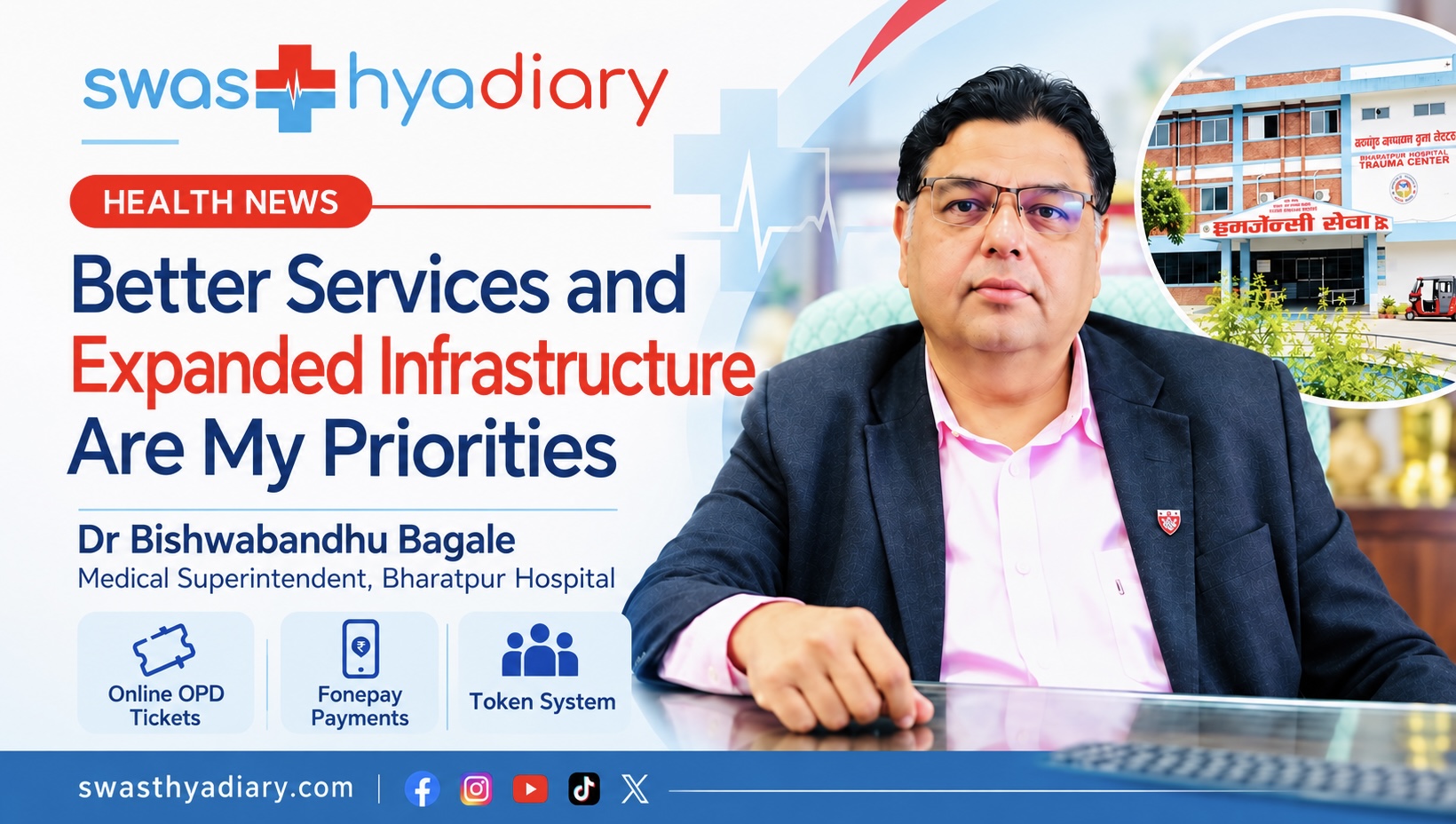

CHITWAN, October 16: Bharatpur Hospital has prioritised managing growing patient numbers, improving the quality of care, introducing technology-supported services and expanding its physical infrastructure. The initiatives aim to make specialist healthcare more accessible, affordable and convenient for the public.
Dr Bishwabandhu Bagale has been serving as the hospital’s 49th chief medical superintendent since Chaitra 26. This is his second term in the role. Hospital records show that he previously served as its 39th medical superintendent from Jestha 2 to Ashadh 18, 2076 BS.
Dr Bagale said the hospital had introduced several digital arrangements to simplify access to services and reduce unnecessary inconvenience for patients. Efforts are continuing to make care more effective, organised and patient-friendly, he said.
Online Tickets and Token Systems
The hospital has introduced online outpatient department (OPD) ticket booking for patients both with and without health insurance. Fonepay payments have also been introduced to simplify the payment process.
Patients can collect their laboratory reports themselves using a report-printing machine, reducing queues and waiting time. Token systems have been introduced at busy service points, including ticket counters, the pharmacy and the laboratory, to improve queue management and organise service delivery.
Plans to Expand Emergency and Critical Care Capacity
The hospital has proposed further infrastructure development to ease overcrowding and improve care. According to Dr Bagale, an observation ward is planned alongside the emergency department to address congestion, bed shortages and difficulties in providing prompt treatment.
Additional private cabins are planned on an upper floor of Block B to respond to complaints about their limited availability. Providing separate beds for patients’ attendants is also among the hospital’s priorities, he said.

The hospital also plans to add intensive care unit (ICU) and high-dependency unit (HDU) beds. The expansion is intended to improve access for critically ill patients and those requiring close monitoring.
Separate Building Proposed for Busy OPD Services
A separate building is proposed for outpatient services that receive particularly high patient numbers. Dr Bagale said general medicine and orthopaedic OPD services could operate from a dedicated building staffed by specialist doctors.
The arrangement is expected to reduce overcrowding, help patients reach the relevant specialists more easily and make the treatment process more organised.
Expanding Digital Services
The hospital has also prioritised expanding digital systems to make services faster, more transparent and more effective. It is working to improve online ticketing, digital payments and access to test reports while increasing the use of technology across its services.
Managing care effectively remains a challenge amid rising patient numbers, limited infrastructure and bed shortages. If implemented, the proposed expansion of emergency, ICU, HDU, cabin and outpatient facilities is expected to reduce difficulties patients face in obtaining care.
Dr Bagale said the hospital would continue to focus on long-term development, infrastructure expansion, access to specialist services and technology-supported service delivery.

Strong Performance in Service Standards Assessment
Bharatpur Central Hospital is a public healthcare institution providing specialist services to patients from many parts of the country. Its performance in the Minimum Service Standards assessment has highlighted its service delivery and institutional capacity.
According to the hospital, it scored 89 points this year in monitoring and evaluation conducted under the Minimum Service Standards programme by the Ministry of Health and Food Hygiene’s quality measurement and regulation division, achieving the leading position among federal hospitals.
The previous year, it ranked first among federal hospitals with a score of 88 per cent in an assessment by the Ministry of Health and Population. It also received a “green zone” sticker awarded to hospitals scoring above 85 per cent. The results reflect its continuing efforts to strengthen service management and improve quality.
From a Health Centre to a Central Hospital
Bharatpur Hospital traces its history to 2013 BS, when it was established as a basic health centre through a joint initiative of the Rapti Dun Valley Development Committee and the United States government. It was renamed Mahendra Adarsha Chikitsalaya in 2020 BS.
Following the People’s Movement of 2062/63 BS, its name was changed to Bharatpur Hospital. The Hospital Development Committee had been established in 2059 BS.
Starting with 15 beds, the hospital had expanded to 415 beds by 2067 BS. It now operates approximately 600 beds under the Government of Nepal and the Hospital Development Committee.
A Cabinet decision on Chaitra 3, 2075 BS upgraded the institution to a specialised hospital. It now operates as a central hospital under the federal government, providing specialist and advanced healthcare services.

A Major Healthcare Destination in Central Nepal
Located in central Nepal, Bharatpur Hospital serves patients from more than 19 districts, including Chitwan, Nawalparasi, Gorkha, Dhading, Makwanpur, Bara, Tanahun, Lamjung and Rupandehi.
Its services play an important role in healthcare across Chitwan and neighbouring districts, with patients travelling considerable distances for specialist treatment. Expanding capacity and infrastructure has become increasingly necessary to maintain accessible, quality care in the public sector.
The hospital receives an average of around 2,500 OPD patients a day. Its records show that daily attendance has reached as high as 3,300.
Potential for a Model Central Hospital
The hospital occupies approximately 31 bighas of land, offering scope for development into a model central hospital. This would require the timely completion of buildings under construction, additional facilities where needed, modern equipment and technology, and effective use of existing infrastructure.
The hospital aims to expand services through infrastructure development guided by its master plan. Alongside construction, staffing and improvements to service systems will be important in meeting growing demand for specialist and modern healthcare.
Its strong Minimum Service Standards results demonstrate both its achievements and potential. Sustaining those gains and ensuring timely access to convenient, affordable and quality treatment remain central priorities.

