






Kathmandu, October 24 — Today is World Polio Day. Although Nepal has not recorded a polio case for many years, challenges remain. With the disease yet to be eradicated globally, continued vaccination and surveillance are essential to protecting the country’s progress.
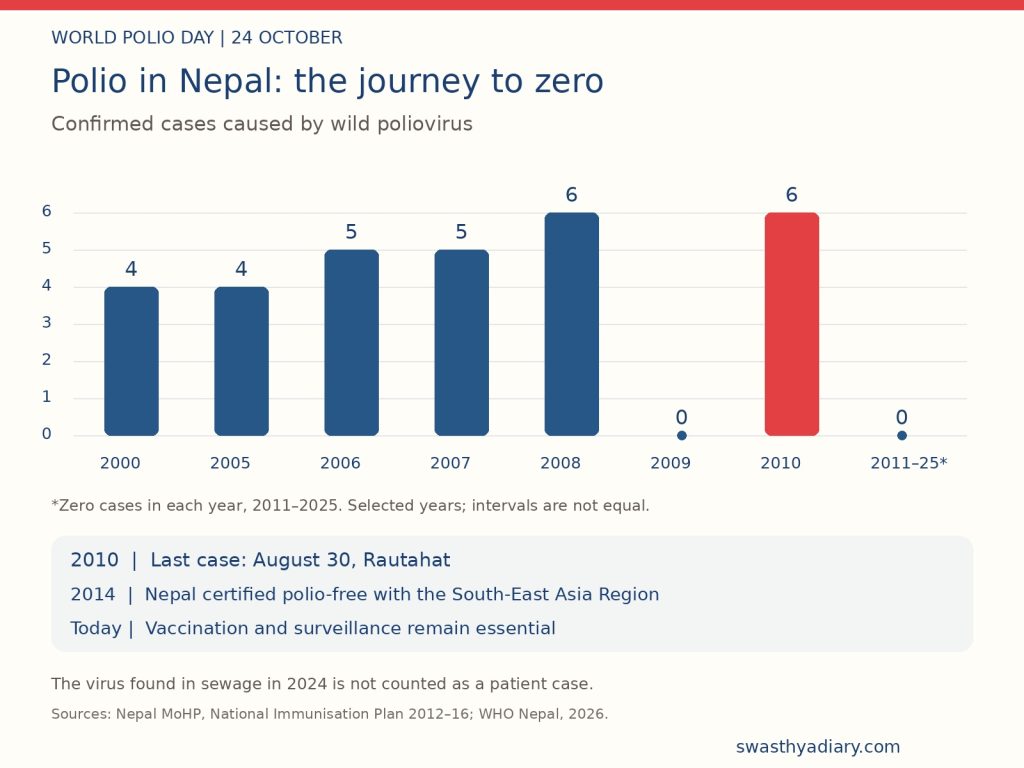
Nepal last recorded a case caused by naturally circulating, or wild, poliovirus in 2010. No new cases caused by this virus have been reported since. However, missed vaccinations, cross-border movement and ongoing transmission in other countries continue to pose risks.
Nepal’s experience shows that reaching zero cases does not mean the risk has ended. According to the Ministry of Health, the country recorded four cases in 2005, five each in 2006 and 2007, and six in 2008. No cases were reported in 2009, but six were confirmed again in 2010.
Protecting South-East Asia’s achievement
The World Health Organization’s South-East Asia Region recorded its last wild poliovirus case in West Bengal, India, in 2011. The region, including Nepal, was certified polio-free in 2014.

Countries across the region have continued vaccination and surveillance to protect this achievement. According to WHO’s South-East Asia Regional Office, more than 50,000 stool samples were tested across the region in 2025. Environmental surveillance was also conducted at 93 sites in five countries.
These surveillance systems help identify suspected cases and detect whether the virus is circulating in communities.
Vaccination and sewage testing in Nepal
Nepal combines routine vaccination with investigations of acute flaccid paralysis—sudden weakness or floppiness of the limbs—and testing of sewage samples. Not every child with sudden limb weakness has polio. However, investigation and laboratory testing help identify possible infections.

According to WHO, Nepal tested 169 sewage samples and investigated 594 cases of acute flaccid paralysis last year. Surveillance found no evidence of poliovirus circulation. The addition of Birgunj brought the total number of environmental surveillance sites to 10.
In 2024, vaccine-derived poliovirus type 3 was detected in a sewage sample in Nepal. A targeted vaccination campaign subsequently reached more than 300,000 children across three districts.
Detecting poliovirus in sewage is different from confirming polio disease in a child. Environmental detection signals the need for investigation and preventive action; it does not, by itself, establish that a person has developed paralytic polio.
That same year, Nepal provided injectable inactivated polio vaccine, or IPV, to around 1.4 million children who had missed vaccination. These efforts highlight the importance of maintaining routine immunisation and reaching children left behind.
A major global decline, but eradication remains unfinished

In 1988, an estimated 350,000 polio cases occurred across more than 125 countries. Cases caused by wild poliovirus have since declined by more than 99 per cent. However, endemic transmission has not been completely interrupted in Afghanistan and Pakistan.
WHO and its partners are working to stop transmission through vaccination campaigns, expanded routine immunisation, cross-border coordination and surveillance. Reaching communities with low vaccination coverage and children who have missed doses remains a central priority.
The same approach is essential to protecting Nepal’s polio-free status. Where children remain unvaccinated, the virus can spread if introduced. National progress must therefore be matched by efforts to ensure that vaccination reaches every community and every child.
There is no cure for polio, but vaccination can prevent it. Parents should check their children’s vaccination cards and confirm with a nearby health facility that all scheduled doses have been completed. Any child who develops sudden weakness or floppiness of the limbs should receive immediate medical attention.

