


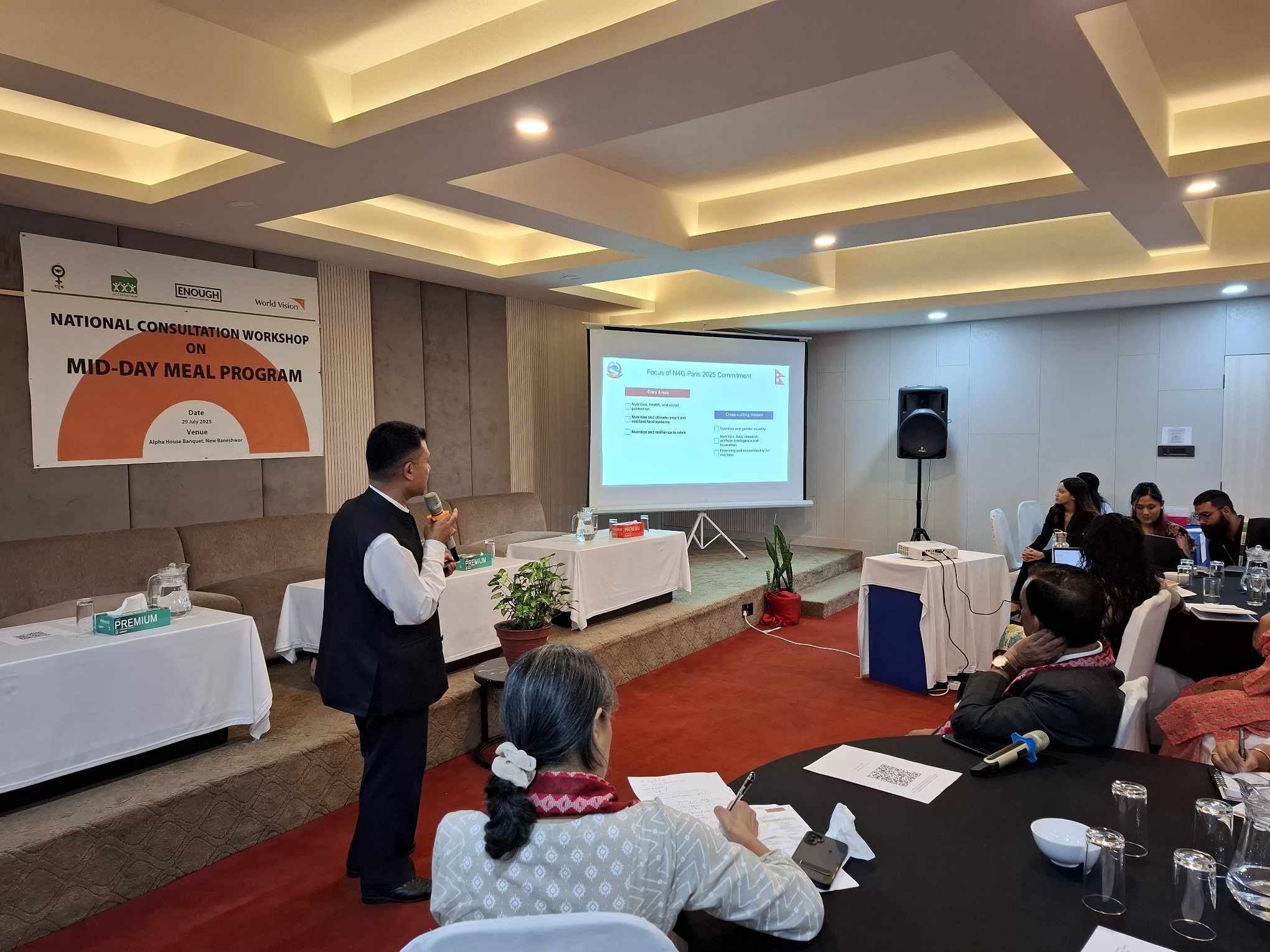


A strong demand has been made to expand Nepal’s current school midday meal program to include children of all grades, ensuring that every student receives a nutritious meal during school hours.
During the National Consultation Workshop on the Midday Meal Program held in Kathmandu on Tuesday, health experts, representatives from concerned organizations, and government officials collectively emphasized the urgent need to provide balanced and nutritious meals to all students, not just those up to Grade 5.
Currently, the government provides a midday meal allowance of NPR 20 per student per day (increased from NPR 15 in the current fiscal year) for students up to Grade 5 in public schools. However, stakeholders argue that this amount is insufficient to ensure a truly nutritious diet.
Urgent Need for Expanded Coverage and Better Nutrition
Workshop participants stressed that proper nutrition is essential for both the physical and mental development of children. They called on the government to ensure every child attending school has access to healthy meals that go beyond simply filling their stomachs.
During the session, Finance Minister Bishnu Prasad Paudel’s earlier announcement of NPR 10.19 billion allocated for the midday meal program in the 2082/83 national budget was acknowledged. However, Sushmita Ramtel, who represented Nepal at the Nutrition for Growth conference in Paris, noted that some schools still face budget shortages, leading them to serve only dry snacks instead of nutritious meals.
Ramtel also raised concerns that many students are now purchasing expired and unhealthy snacks from nearby shops. She urged authorities to increase monitoring of such vendors and emphasized the importance of raising awareness among parents. Furthermore, she recommended integrating locally produced food items into the school meal system.
Nutrition Beyond Calories: Experts Call for Coordinated Effort
Dr. R.P. Bichha, pediatrician and member of the National Planning Commission, highlighted the importance of implementing nutrition programs in alignment with Nepal’s constitution. He voiced concern over fragmented efforts by donor agencies and stressed that nutrition should not just focus on quantity but on quality—balanced, healthy food.
Dr. Bichha also expressed alarm over the declining trend of exclusive breastfeeding in Nepal under the guise of modernization. He explained that exclusive breastfeeding for the first six months helps build up to 163 types of antibodies in a child’s body. He called for the entire family, not just mothers, to support proper maternal nutrition.
School Meals Linked to Enrollment, Attendance, and Learning
Chandrakanta Bhusal, Director General at the Center for Education and Human Resource Development, presented findings from national and international studies showing that school meal programs significantly boost student enrollment, class attendance, completion rates, and learning outcomes.
Similarly, Shivarajan Paudyal from the National Planning Commission’s Social Development Division stressed that investing in child nutrition is critical for holistic development, referencing data shared at the Paris conference.
Pinky Singh Rana, Executive Board Member of the Rural Women Development and Unity Center (RUWDUC), one of the workshop’s organizers, stated that the meal program plays a vital role in improving children’s nutritional status, cognitive growth, and learning performance. According to her, the program also helps parents save on meal costs, indirectly contributing to household social security.
Local Leadership and Unity Are Key
Speaking at the event, Shyam Adhikari from World Vision International urged school management committees and local government representatives to take leadership roles in uniting all stakeholders. He emphasized that the midday meal program must be scaled effectively to ensure the healthy development of young children, whom he referred to as “fragile buds.”
The national consultation was jointly organized by the Rural Women Development and Unity Center (RUWDUC), World Vision International, ENPHO (Environment and Public Health Organization), and the Community Information Network (CIN).
